Fashion Development & Apparel Manufacturing Insights
China remains a major sourcing base for global menswear, supported by deep fabric networks, skilled sewing teams, and mature export infrastructure. The WTO’s World Trade Statistical Review 2024 places China at roughly one-third of global clothing exports in 2023. That scale matters to buyers. It can support competitive pricing, flexible product development, and reliable access to cotton, wool, denim, fleece, and technical fabrics.
This guide introduces China’s top 10 Menswear cut and sew factory options for international buyers. The selection considers sampling quality, minimum order quantities, production capacity, fabric sourcing, quality control, lead times, and export experience. It also considers practical details, such as whether a factory can keep sleeve lengths consistent across 5,000 jackets. Small details become expensive problems.
McKinsey’s The State of Fashion 2025 describes a cautious market shaped by weak consumer confidence, rising costs, and changing demand. Buyers therefore need more than attractive factory photos. They need clear specifications, pre-production samples, inspection procedures, and documented social compliance. Certifications can help, but they are not perfect proof. An audit report may look polished while the production floor tells another story.
No ranking is permanent. Factory capacity, management, and subcontracting practices can change quickly. This list should support research, not replace direct verification. Buyers should request recent references, confirm machinery, review test reports, and inspect finished garments before placing large orders. The best supplier is not always the largest. It is the one that communicates clearly, controls quality consistently, and can repeat the approved sample without unpleasant surprises.
What Defines a Leading Menswear Cut and Sew Factory in China
A leading menswear cut and sew factory in China is defined by repeatable execution, not impressive sample-room photos. The WTO’s World Trade Statistical Review 2024 reported that China supplied about 31.6% of global clothing exports in 2023. That scale creates strong technical experience, but buyers still need evidence at factory level.
Look for documented production controls. A capable team checks fabric shrinkage, colorfastness, seam strength, and measurement tolerance before bulk cutting. It should separate cutting, sewing, pressing, and final inspection records. An AQL-based inspection system can make defects measurable, while ISO 9001 procedures support consistent corrective actions. Ask to see recent test reports, machine-maintenance logs, and operator training records. Real proof matters more than polished presentations.
Material capability also matters. Textile Exchange’s 2024 Materials Market Report estimated global fiber production at 124 million tonnes in 2023, with polyester representing roughly 57%. A dependable factory should explain fiber content, recycled inputs, dyeing risks, and traceability without vague claims. It should manage small samples and larger orders with the same discipline. Lead-time promises must include fabric booking, approvals, rework, and shipping preparation.
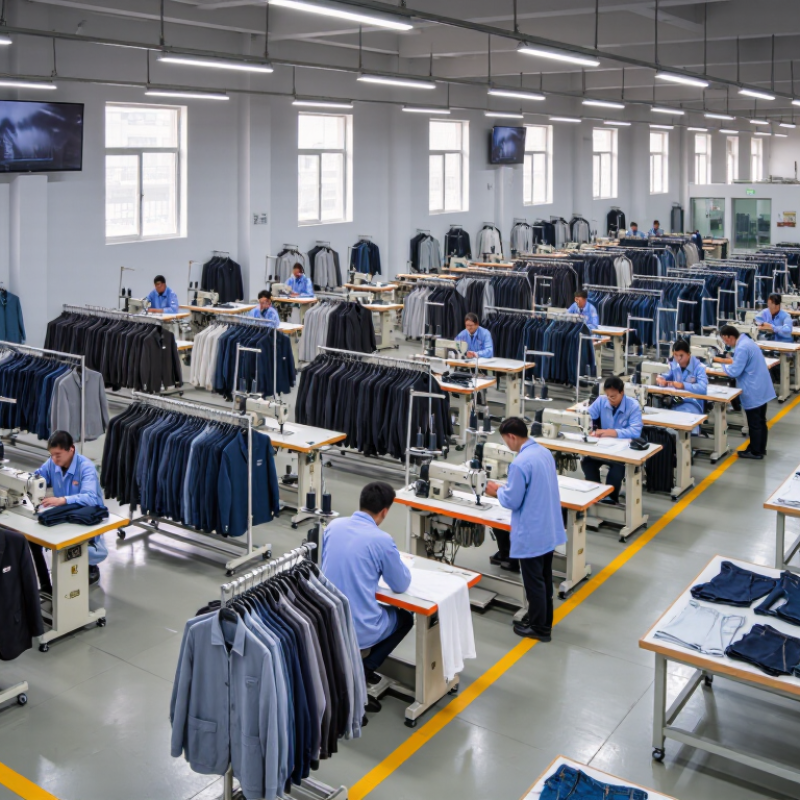
The factory floor tells another story. Are measurement charts visible beside operators? Are rejected panels tagged, isolated, and reviewed? These details reveal management maturity. No factory is flawless. I would question any supplier claiming zero defects or unlimited capacity. Sometimes a slower, transparent response is more reliable than a perfect sales answer.
China Top 10 Menswear Cut and Sew Factories for Buyers - What Defines a Leading Menswear Cut and Sew Factory in China
| Rank | Factory Profile | Main Production Region | Menswear Specialization | Typical Monthly Capacity | Typical MOQ per Style/Color | Sample Lead Time | Bulk Lead Time | Quality and Compliance Strengths | Best Fit for Buyers |
|---|---|---|---|---|---|---|---|---|---|
| 01 | Profile A | Jiangsu | Tailored jackets, wool-blend coats, structured trousers | 30,000–50,000 pieces | 300–500 pieces | 7–12 days | 45–60 days | Strong pattern making, fusing control, inline inspection and final AQL checks | Mid-market and premium formalwear programs |
| 02 | Profile B | Zhejiang | Casual shirts, overshirts, linen and cotton woven tops | 50,000–80,000 pieces | 200–400 pieces | 5–10 days | 35–50 days | Flexible fabric sourcing, reliable color matching and efficient cutting rooms | Independent labels and seasonal casual collections |
| 03 | Profile C | Guangdong | T-shirts, polo shirts, sweatshirts and jersey basics | 80,000–150,000 pieces | 500–1,000 pieces | 5–8 days | 30–45 days | High-volume sewing lines, fabric testing and stable repeat-order performance | Large-volume basics and promotional apparel buyers |
| 04 | Profile D | Fujian | Denim jackets, jeans, workwear and washed garments | 35,000–70,000 pieces | 300–600 pieces | 8–14 days | 45–65 days | Garment washing coordination, shade control, bartacking and heavy-duty stitching | Workwear, streetwear and durable casualwear collections |
| 05 | Profile E | Shanghai–Jiangsu Area | Premium shirts, refined casualwear and light outerwear | 20,000–40,000 pieces | 150–300 pieces | 7–14 days | 40–55 days | Small-batch development, detailed finishing and strong technical-pack support | Premium small and medium-sized fashion collections |
| 06 | Profile F | Shandong | Knitwear, polo shirts, cardigans and lightweight sweaters | 25,000–50,000 pieces | 300–500 pieces | 10–18 days | 45–70 days | Gauge control, shrinkage testing, pilling assessment and linking expertise | Autumn/winter menswear and smart-casual knit programs |
| 07 | Profile G | Hubei | Uniforms, corporate shirts, trousers and service apparel | 60,000–120,000 pieces | 500–1,000 pieces | 7–12 days | 35–55 days | Repeatable sizing, bulk order planning, embroidery and heat-transfer coordination | Institutional, hospitality and corporate apparel procurement |
| 08 | Profile H | Zhejiang | Outdoor shirts, softshell jackets and functional casualwear | 30,000–60,000 pieces | 300–500 pieces | 8–15 days | 45–60 days | Seam-sealing coordination, performance fabric handling and functional trim sourcing | Outdoor, travel and performance-inspired menswear |
| 09 | Profile I | Guangxi | Rayon shirts, resortwear, relaxed trousers and vacation apparel | 25,000–55,000 pieces | 200–400 pieces | 6–12 days | 35–50 days | Print placement control, lightweight fabric handling and low-to-medium MOQ flexibility | Resort, holiday and contemporary casualwear buyers |
| 10 | Profile J | Anhui | Value menswear, chinos, casual jackets and everyday basics | 70,000–130,000 pieces | 500–1,000 pieces | 6–10 days | 30–45 days | Cost-efficient production, standardized operations and strong capacity planning | Retail programs requiring competitive pricing and consistent replenishment |
Note: The factory profiles are anonymized. Capacity, MOQ and lead-time figures represent practical sourcing ranges for China-based menswear cut-and-sew production and should be confirmed through factory audits, approved samples, testing reports and purchase-order terms.
FAQS
Factories commonly produce structured jackets, lightweight shirts, jersey garments, fleece, and performance blends. Construction varies.
Minimum orders often range from 300 to 1,000 pieces per style. Fabric, dyeing, and construction affect the final requirement.
Sampling commonly takes 7–15 days. Bulk production often needs 30–60 days. Custom dyeing may add two weeks.
Send each factory the same tech pack, fabric details, and quantity levels. Request prices for three order volumes. This can reveal hidden setup costs.
Request fabric GSM, shrinkage results, colorfastness records, and a pre-production sample. Measure garment dimensions and seam strength. Wash testing matters.
Request fiber certificates, supplier records, and batch-level documentation. Do not rely on fabric labels alone. Paperwork can still contain gaps.
Yes, a pilot order can reveal sizing, stitching, shrinkage, and packing problems. Check fabric rolls are labeled and stored off the floor. Early samples are rarely perfect.
Watch for unclear revisions, crowded aisles, weak lighting, and unfinished cartons. A polished showroom proves little. I would still inspect personally.
Conclusion
This guide presents the key qualities of a leading Menswear cut and sew factory in China, including professional pattern development, skilled sewing teams, reliable quality control, flexible production capacity, and experience with different fabrics and garment structures. It explains how the top ten factories are selected by reviewing their manufacturing capabilities, product specialization, equipment, workforce, production consistency, communication, and ability to support both development and bulk orders.
Each factory profile highlights its specialties, technical strengths, order flexibility, minimum quantities, pricing factors, quality standards, and typical lead times. The guide also compares these considerations to help buyers understand the balance between cost, craftsmanship, speed, and production scale. Finally, it offers a practical evaluation framework covering samples, factory audits, certifications, communication efficiency, quality assurance, payment terms, and delivery performance, enabling buyers to choose a suitable manufacturing partner for their menswear projects.