

Fashion Development & Apparel Manufacturing Insights
How to Find a Top Custom Streetwear Manufacturer in China?
Table of Contents
- Define Your Streetwear Specs: Fabric GSM, Fit, Prints, and Order Volume
- Screen Chinese Manufacturers for Capacity, Certifications, and Export Experience
- Compare Sample Quality, MOQ, and Lead Times Before Placing an Order
- Inspect Fabric with ASTM D5430’s 4-Point System
- Set Garment Acceptance Criteria Using ISO 2859-1 and AQL 2.5
- FAQS
- Conclusion
- Related Posts
Streetwear can look effortless: a heavyweight hoodie, a clean neckline, and a graphic that sits exactly right. Producing it consistently is harder. Grand View Research’s 2023 Streetwear Market report estimated the global market at USD 187.9 billion in 2023 and forecast a 3.5% compound annual growth rate from 2024 to 2030. These are market estimates, not guarantees of demand for any particular label. Still, they show why buyers need more than an attractive factory quote.
Custom streetwear manufacturing depends on fit, fabric, finishing, and repeatable quality. China’s supplier base can offer broad material and production options, but capabilities vary from factory to factory. Request a size-set sample, inspect stitching and print placement, and confirm fabric weight in GSM. Ask who handles pattern grading, labels, packaging, and production updates. Get the minimum order quantity, sample fees, lead times, and defect policy in writing. Small details matter. One washed sample may reveal shrinkage that a product photo cannot.
Toyota production expert Taiichi Ohno’s principle, “Where there is no standard, there can be no kaizen,” offers a useful test for any manufacturer. For streetwear, clear measurement sheets and documented approval samples create that standard. A polished sample is not proof of reliable bulk production. No checklist is perfect. Buyers should compare sample quality with a pre-shipment inspection and keep room for honest revisions. This guide explains how to assess suppliers, ask sharper questions, and choose a partner whose process—not just presentation—fits your brand.
Define Your Streetwear Specs: Fabric GSM, Fit, Prints, and Order Volume
Before approaching a Chinese streetwear manufacturer, turn your concept into a measurable tech pack. State fiber composition, fabric weight, color, and finish. A heavyweight T-shirt might start around 220–280 GSM; a substantial hoodie, 350–450 GSM. These are starting points, not rules. Feel the sample in hand: a dense fabric can still hang poorly if its knit or finish is wrong.
Fit needs numbers, not just “oversized.” Provide garment measurements for each size, including chest width, body length, sleeve length, and acceptable tolerances. Ask for a graded size set and a washed sample to check shrinkage and shape retention. Small details matter. For prints, specify artwork dimensions, placement from seams, colors, and whether you want a soft or raised feel. Request a wash test before approving bulk production.
Order volume affects pricing, fabric availability, and setup costs, so list quantities by color and size. Ask the factory to quote samples, minimum order quantities, and bulk pricing separately. Textile Exchange’s 2024 Materials Market Report estimated global fiber production at 124 million tonnes in 2023, with polyester representing 57%. That scale makes clear why composition and sourcing should be stated precisely. Test it first. A sample may look right under studio lights but feel different after washing; allow time to revise it.
Screen Chinese Manufacturers for Capacity, Certifications, and Export Experience
A top custom streetwear manufacturer should prove its capabilities with records, not polished showroom displays. Ask for monthly capacity by product type, then compare it with your order size and delivery window. A factory making 8,000 hoodies monthly may still struggle when several clients launch seasonal orders together. Request a production plan showing cutting, sewing, printing, and finishing stages. Check whether key processes happen in-house or rely on outside workshops. This detail can affect quality control and lead times.
Review relevant certifications carefully. Confirm the issuing organization, validity dates, and whether the certificate covers the actual factory and processes you plan to use. A certificate on a company profile is not enough. Ask for recent audit records or arrange an independent factory assessment. For export experience, request examples of shipping documents with sensitive details removed, plus references from buyers in comparable markets. Check familiarity with product specifications, packing lists, and shipment scheduling. These checks matter, but they cannot guarantee every production run will be smooth.
Tips: Request a small pilot order before committing to bulk production. Compare its measurements, stitching, print placement, and fabric weight with your approved sample. Keep written records of changes. No checklist removes risk, and a neat sample room can hide weak production controls. Verify details on-site or through a qualified third party when the order is significant.
Compare Sample Quality, MOQ, and Lead Times Before Placing an Order
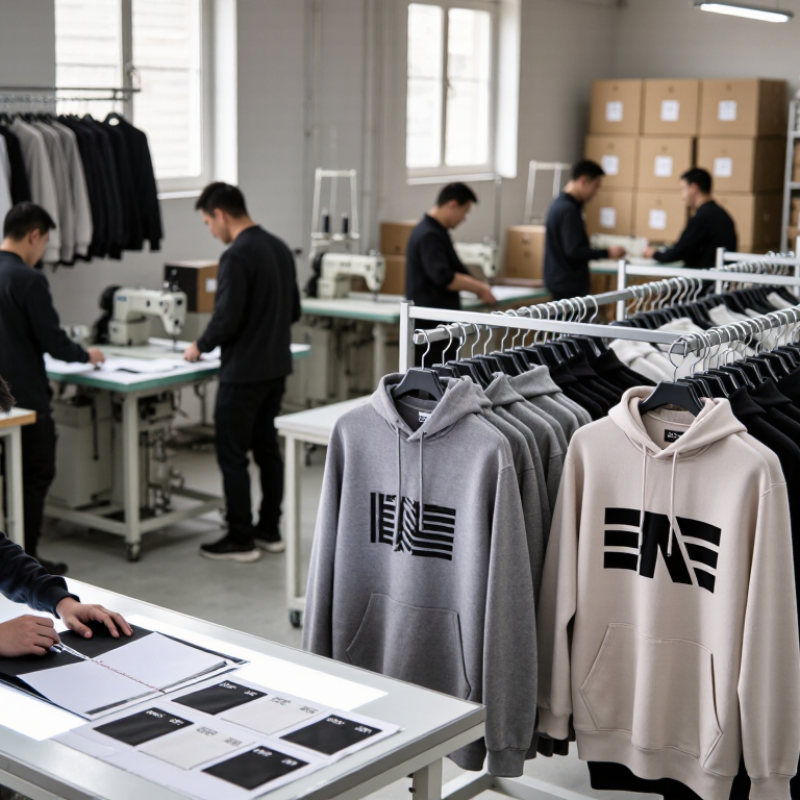
A strong custom streetwear manufacturer should be assessed with the same garment details you plan to order. Request a sample using your actual fabric weight, print method, labels, and size specifications. Check the seams, collar recovery, print placement, and how the fabric feels after washing. Look closely. A polished sample can still hide inconsistent stitching or a fit that changes between sizes. Ask whether the sample was made on the production line or by a separate sample team.
Compare minimum order quantities against your budget and design complexity. A low MOQ may cost more per piece, while a larger run can leave you holding unsold sizes. Ask for pricing at several quantities, and confirm whether colorways count separately. Get the answers in writing. It is easy to overlook setup fees or fabric minimums when focusing only on the headline price.
Lead times need the same careful comparison. Ask how long sampling, revisions, bulk production, and packing each take. Request a production calendar with dates, not just a broad estimate. Confirm what happens if fabric arrives late or a sample needs another adjustment. Shipping time is separate, and seasonal factory peaks can shift schedules. I have seen tidy timelines look reassuring; they are not proof that every step is under control. Check progress updates before committing.
How to Compare China Streetwear Manufacturers
Compare minimum order quantities (MOQ) and estimated timelines across order scales. Use these realistic planning examples as a starting point—not as verified market averages—and confirm each figure directly with suppliers.
Sample quality: Request a physical sample and check fabric weight, stitching, print or embroidery, fit, labels, and finishing against your specification. Sample and production timelines vary with design complexity, fabric availability, and revision rounds.
Inspect Fabric with ASTM D5430’s 4-Point System
When assessing a custom streetwear manufacturer in China, ask how fabric is inspected before cutting. ASTM D5430’s 4-point system assigns 1 to 4 points according to defect length: up to 3 inches earns 1 point; over 9 inches earns 4. Inspectors mark flaws such as holes, slubs, and shade streaks, then record scores against the inspected fabric area. Agree on the inspection method and acceptable score before production starts.
Ask to see an actual roll inspection record, not just a quality-control promise. A practical check uses consistent lighting, a measured inspection table, and clear notes showing each defect’s location. Compare rolls using the same scoring rules.
Textile Exchange’s Materials Market Report 2024 estimates that global fiber production reached 124 million tonnes in 2023. At that scale, small inconsistencies can travel far through a supply chain. A clean score is useful, not magical. Inspectors may disagree on borderline flaws, so request photos and keep a retained fabric swatch for comparison.
The 4-point score does not judge colorfastness, shrinkage, or hand feel. Check those separately with agreed test methods and sample approval. Ask the factory to explain how it handles a roll that exceeds your limit, including whether it isolates affected sections before cutting. That answer often reveals more than a polished inspection sheet.
Set Garment Acceptance Criteria Using ISO 2859-1 and AQL 2.5
When evaluating a custom streetwear manufacturer in China, agree on garment acceptance criteria before bulk production. ISO 2859-1 provides a lot-by-lot sampling framework. Set the inspection level and plan in writing; the required sample size and accept-or-reject numbers depend on the lot size and chosen level. AQL 2.5 is a sampling benchmark, not a promise that every shipment will contain exactly 2.5% defects. Not a guarantee. Define defect classes clearly: a skipped stitch or uneven print may be major, while a loose thread may be minor. Your team should decide these classifications before inspection.
Tips:
Check actual garments against approved samples and measurement tolerances. Inspect collar shape, seam strength, print placement, color consistency, labels, and packing. Record findings with clear photos and garment measurements. Keep inspection conditions consistent, including lighting and measurement tools. If a lot fails, agree on rework, replacement, or reinspection steps before shipment.
A sampling inspection cannot reveal every flaw, so review production controls as well. Ask how the factory separates inspected pieces and tracks corrections. For a hoodie order, for example, check several sizes rather than inspecting only medium. Document the sample plan, AQL level, defect definitions, and acceptance numbers in the purchase specification. Small details matter. Revisit the criteria after each run; a checklist can miss a problem your team did not anticipate.
FAQS
Match the sample to your planned fabric weight, print method, labels, and size specifications. Check stitching, collar recovery, and print placement. Wash it and feel the fabric again. Look closely. Ask whether the sample came from the production line or a separate sample team.
Request prices at several quantities and confirm whether each colorway has a separate minimum. A low minimum can mean a higher per-piece cost. A larger run may leave you with unsold sizes. Check setup fees and fabric minimums in writing.
Ask for separate timelines for sampling, revisions, bulk production, packing, and shipping. Request dated production milestones, not just a broad estimate. Confirm what happens if fabric arrives late or a sample needs changes. Seasonal peaks can shift schedules.
No. AQL 2.5 is a sampling benchmark, not a promise about the exact defect rate in every shipment. Agree on the inspection level, sample plan, and acceptance numbers. Not a guarantee.
Define defect classes before inspection. A skipped stitch or uneven print may be major; a loose thread may be minor. Your team should agree on these examples in writing. Some borderline cases may still need discussion.
Compare garments with the approved sample and measurement tolerances. Check collar shape, seam strength, print placement, color, labels, and packing. Use consistent lighting and measuring tools. Record photos and measurements.
Yes. For a hoodie order, inspect several sizes rather than checking only medium. Fit and measurements can vary across the size range. I might still miss an issue, so review findings carefully.
Agree in advance on rework, replacement, or reinspection before shipment. Ask how inspected pieces are separated and how corrections are tracked. Keep the sample plan and defect definitions in the purchase specification. Revisit them after each production run.
Conclusion
Finding a top custom streetwear manufacturer in China starts with a clear product brief. Define your fabric weight in GSM, preferred fit, print or decoration methods, size range, and expected order volume before contacting factories. Then assess each manufacturer’s production capacity, relevant certifications, quality-control processes, and experience exporting to your market. These details help you identify a partner whose capabilities match your needs and communication expectations.
Before committing to production, compare samples for construction, fit, print quality, and fabric feel, while confirming minimum order quantities and realistic lead times. Fabric inspection can follow ASTM D5430’s 4-point system to identify and document defects consistently. For finished garments, establish written acceptance criteria and use ISO 2859-1 sampling with an AQL of 2.5 as a practical inspection framework. A structured approach to custom streetwear manufacturing can reduce avoidable surprises and support more consistent results from sampling through final production.

Blog Tags: